It is no secret that the web hosting industry is the target of a lot of fraudsters, scammers, spammers and various run-of-the-mill riffraff. The anonymity that the Internet can provide seems to be far too fertile of ground for those simply looking to take advantage. It would be fantastic if everyone was always honest and never attempted to proverbially hoodwink those that are either more honest or less naive than themselves. However, the world we live in is one in which many things simply cannot, and should not, be taken at face value.
Fortunately, the Internet is also an excellent tool for exposing various scams and raising awareness such that less people are prone to being taken advantage of; the pyramid schemes that Grandma fell for (it’s true, she did; ask her about it) via snail-mail back in the day are simply not possible these days. So, schemes and scams have evolved. As HostGator has grown over the years, we have become a larger and larger target for scammers.
We like to think these days that it’s pretty hard to get one over on us, we’re pretty sharp cookies with pretty keen eyes. This wasn’t always necessarily true. The scam that I am about to describe to you, when it was first perpetuated on us, did initially cost us about $20,000. We were ultimately reimbursed these funds, but lesson learned!
In it’s most simple form, the scam works like this: Scammy McScammer targets a business or an individual and engages in the act of purchasing an item from them. Let’s say the item in question costs $500. Scammy will then send a check via FedEx or Priority USPS for $700 and contact the seller to inform them that they either “accidentally” or for some other made-up reason sent a check that was greater than the amount due and request that the balance be returned to them, in some way convincing the target that they should go ahead and send the amount prior to the initial check actually clearing… because it won’t. The target sends the scammer a good check, which the scammer promptly cashes. The fake check of course bounces and the scammer then has the target’s money. Where does the scammer get these fake checks? Anyone can easily purchase check-making software from virtually any office supply store and begin printing checks, be they for legitimate or illegitimate purposes. If you have ever seen the movie Catch Me If You Can, it’s basically a modern day version of that scenario.
Where does HostGator fit into this scam? We definitely didn’t receive fake checks and then mindlessly send out real ones. What happened was scammers made fake HostGator checks (with real account and routing numbers) and sent those to their targets. There are now multiple safeguards in effect to prevent this from ever being successful, so please don’t use this blog post as a how-to for beginning your scamming career. We do receive about a dozen fake checks each month that are used in an attempt to scam an innocent individual or business.
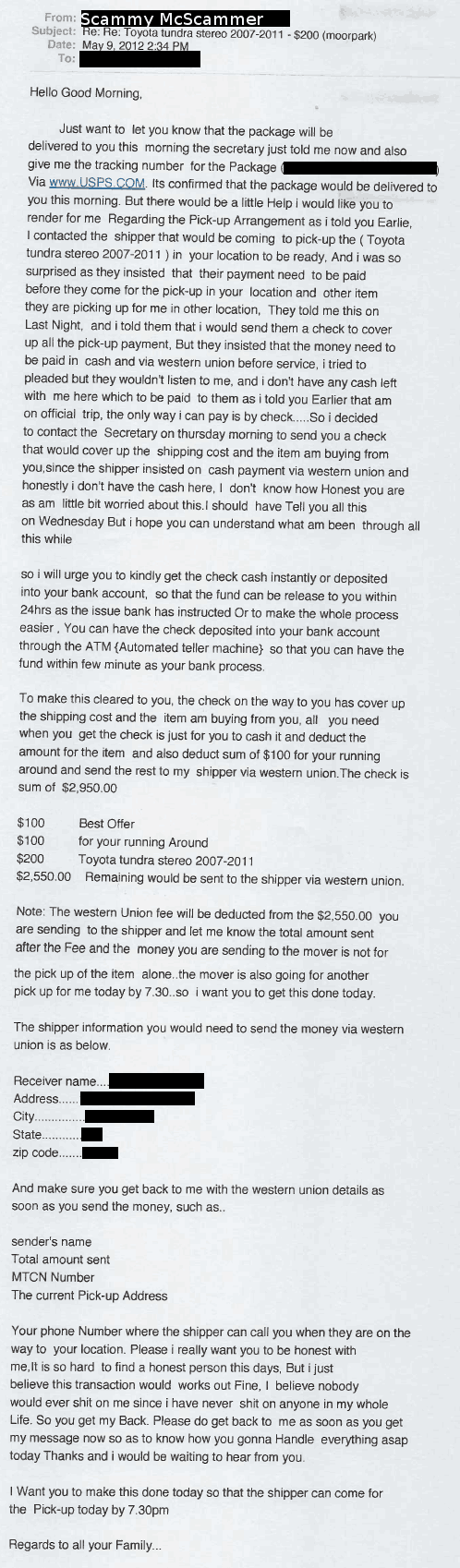
The most recent attempt to utilize this scam involved a $2,850 check and the request to purchase a $100 Toyota Tundra factory stereo on Craigslist. Essentially, the scammer said “here’s a $2,850 check, please deposit it into your ATM and take out the cash, keep an extra $100 for your trouble and send the rest to me via Western Union.” Seriously. If you’d like to see the actual email, click here.
The intended target of this scam smelled a rat and contacted us, as is what most often happens in these cases. We now have not only the email that I shared with you, but also the original check and even the USPS envelope that was used by the scammer. We also have a very healthy relationship with various levels of law enforcement.
Do not let yourself fall victim to an Internet scammer! If something seems too good to be true, then it is. If something seems like a scam, it is. Don’t fall prey and don’t hand your hard-earned money over to any two-bit trickster. Notify the proper authorities and let’s put criminals where they belong.